
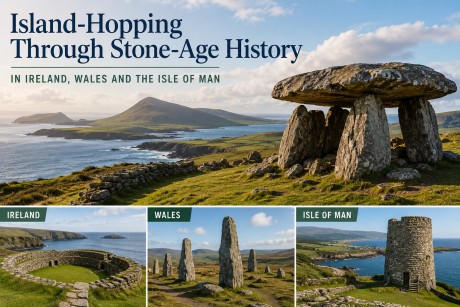
Embarking on a journey around the Irish Sea allows travelers to delve into the captivating prehistoric landscapes of the British Isles. This route unveils a tapestry of ancient tombs, Celtic landmarks, and historical sites, intertwined with scenic ferry voyages that connect Ireland, Wales, and the Isle of Man.
The adventure kicks off in Pembrokeshire, Wales, where visitors encounter Pentre Ifan—a striking Neolithic burial site dating back to approximately 3500 BC. The monument’s imposing stones set against a remote backdrop introduce the significant prehistoric heritage that encircles the Irish Sea.
From the shores of Wales, the journey extends via ferry to Ireland, a land boasting some of Europe’s most remarkable Neolithic wonders. North of Dublin lies Newgrange, the centerpiece of the Irish section of this route. Constructed over 5,000 years ago, this massive passage tomb features a long corridor leading to a central chamber adorned with ancient carvings. Newgrange is renowned for its association with the winter solstice, when sunlight penetrates an opening above the entrance, illuminating the chamber—a testament to the builders’ extraordinary astronomical acumen. Additional noteworthy sites include Glendalough, a historic monastic settlement in County Wicklow, along with Trim Castle and the Hill of Tara, the latter traditionally linked to Ireland’s ancient monarchs.
Continuing from Ireland, the route leads travelers to Belfast and then across the Irish Sea to the Isle of Man. Here, the experience of ancient history takes on a different dimension, with prehistoric monuments scattered across the open countryside, often accompanied by modest visitor facilities. The island invites exploration of Celtic crosses, archaeological sites, and the Manx Museum, all set against a backdrop of distinct cultural heritage.
Among the most atmospheric locations on this journey is Cashtal yn Ard, a Neolithic passage tomb nestled in the Manx landscape. Though partially collapsed, the remaining stones delineate the original entrance, passage, and burial chamber. Its peaceful setting amidst fields and hills offers visitors a chance to appreciate the site away from the crowds typical of larger archaeological attractions. This island-hopping exploration around the Irish Sea presents an extraordinary opportunity for those captivated by archaeology, history, and unique landscapes, blending prehistoric monuments with picturesque road trips and ferry crossings.