
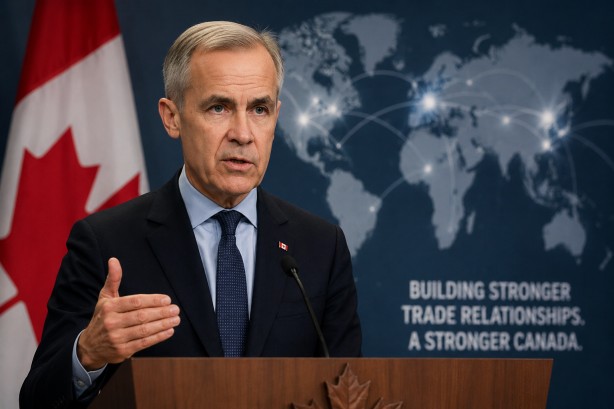
Mark Carney, the Canadian Prime Minister, has recently drawn attention to a notable shift in Canada’s diplomatic strategy, particularly in its dealings with the United States, against the backdrop of an evolving global landscape. In a notable address at the World Economic Forum held in Davos, Carney underscored the increasing fractures within the international order, urging middle powers to enhance their collaborative efforts. He advocated for countries to forge alliances grounded in mutual interests and to diminish reliance on any single dominant global power.
Carney’s emphasis on strategic diversification came into sharper focus with his recent declaration that Canada will be withdrawing from trade discussions with the United States. This decision comes in response to persistent tensions stemming from tariffs and various trade policies. By opting to step away, Canada is clearly signaling its intent to broaden its range of international partnerships, thereby reducing its economic reliance on the U.S.
While acknowledging the substantial economic interconnections between Canada and the United States, Carney also highlighted a critical need to safeguard Canada’s sovereignty and long-term national interests. This approach marks a strategic pivot, as Canada seeks to balance its economic interests while ensuring its own autonomy on the global stage.
The implications of these growing trade tensions could extend beyond bilateral relations, potentially affecting the broader framework of economic cooperation across North America. As Canada positions itself to cultivate stronger ties with other global partners, the dynamics of regional and international trade could see significant shifts.