
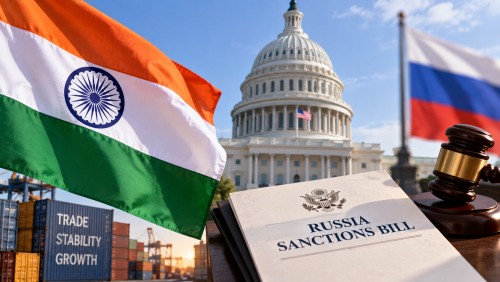
The global energy landscape faces potential shifts following the recent passage of a sanctions bill by the U.S. House of Representatives, targeting countries heavily reliant on Russian oil. As tensions mount over energy security, India has pledged to safeguard its economic interests amidst these developments.
On Thursday, India’s Ministry of External Affairs announced its commitment to ensuring energy security for its population of 1.4 billion, in response to the U.S. House’s approval of the Lindsey O. Graham Sanctioning Russia and Iran Act of 2026. This legislation, which passed with a 262-159 vote, threatens to impose tariffs of up to 100% on nations that maintain significant trade with Russia, including India, China, Slovakia, Hungary, and Azerbaijan.
With the bill having cleared the Senate, it now awaits presidential approval to become law. The potential enactment has sparked concerns regarding its impact on India-U.S. trade relations and the broader global energy markets. India’s government has proactively engaged with U.S. officials at senior levels to discuss the potential ramifications and is collaborating with national trade and industry bodies to mitigate any adverse economic outcomes.
In an effort to diversify its energy sources, India has ramped up oil purchases from countries such as the United States and Venezuela in recent months. Despite this diversification, Russia remains a key supplier of crude oil to India, highlighting the challenges the sanctions could pose to India’s energy strategy.
As the international community watches closely, India’s strategic response to the evolving geopolitical climate will be critical in navigating its energy security and maintaining robust economic ties globally.