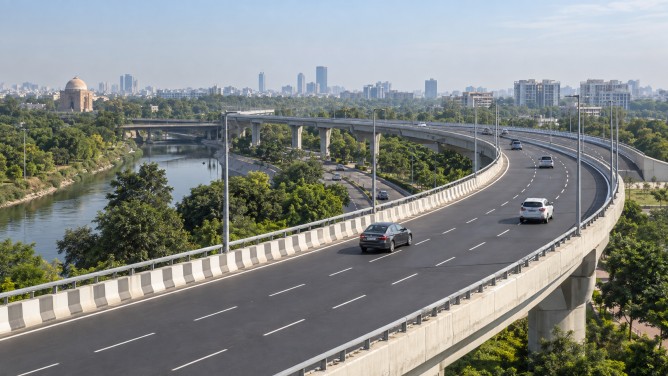
In the face of persistent delays caused by land acquisition issues, construction hurdles, and the COVID-19 pandemic, Delhi is set to inaugurate a key infrastructure project aimed at easing traffic congestion. The much-anticipated Barapullah Phase III elevated corridor is scheduled to open on September 29. This development promises to significantly enhance connectivity between Mayur Vihar in East Delhi, Noida, and important areas in South Delhi.
The 3.5-kilometer elevated corridor will establish a vital link from Mayur Vihar Phase I to Sarai Kale Khan, integrating seamlessly with the existing Barapullah corridor. This integration is expected to create a largely signal-free route, potentially slashing travel times between these regions. Currently, journeys that take approximately 35 to 40 minutes could be reduced to around 15 minutes, depending on traffic conditions.
Designed with modern infrastructure, the four-lane corridor incorporates a bridge over the Yamuna River, nine traffic-distribution loops, and several connecting ramps. The project also includes dedicated bicycle tracks and pedestrian facilities, reflecting a commitment to sustainable and accessible urban transport solutions.
Originally approved in 2014, the Barapullah Phase III project commenced construction in 2015. However, it has faced numerous setbacks, resulting in significant delays and an increase in estimated costs from ₹1,260 crore to approximately ₹1,635 crore. Despite these challenges, major structures like the Yamuna bridge and the essential ramps have reached completion, with final preparations underway for the imminent opening.
As Delhi prepares for the corridor’s inauguration, officials are optimistic about its potential to transform commuting patterns in the region. By alleviating traffic bottlenecks, the project is expected to offer a more efficient travel experience for commuters traveling between East Delhi, Noida, and South Delhi, including destinations like the All India Institute of Medical Sciences (AIIMS).