
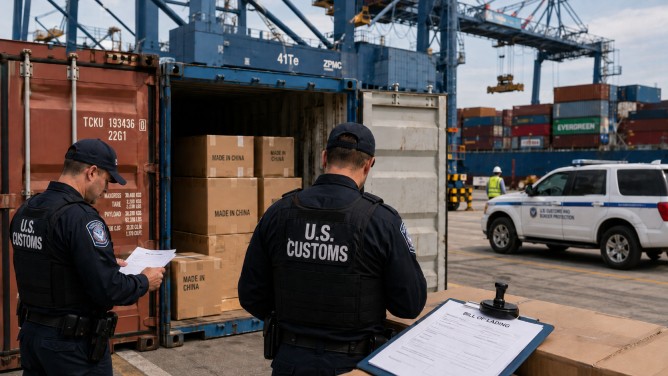
The United States has made allegations against 38 nations and the European Union, accusing them of forming a “shadow transshipment network.” This network is said to facilitate the entry of Chinese goods into the American market by routing them through intermediary countries to avoid high tariffs imposed by the US. The findings, presented in a report titled “The Great Transshipment Scam,” suggest that such activities may involve approximately $60 billion in potentially illegal transshipments, significantly impacting US tariff revenues.
Among the countries and territories implicated in this report are major economies and trading hubs, including India, Canada, the European Union, Israel, Japan, and Mexico. Other nations listed are South Korea, Taiwan, Brazil, Indonesia, Malaysia, Thailand, and Turkey. Smaller players such as Vietnam, Argentina, Azerbaijan, Bangladesh, and Cambodia are also named, along with Chile, Colombia, Costa Rica, the Dominican Republic, and Georgia. The list extends to include Jordan, Kazakhstan, Kenya, Laos, Morocco, Myanmar, Oman, Panama, Peru, the Philippines, Singapore, Sri Lanka, Switzerland, the UAE, and Uzbekistan.
The report estimates that in the year 2025, about $67 billion worth of goods destined for the US market were allegedly rerouted from China through key conduits like Mexico, India, and Vietnam. This practice is believed to have caused a loss of approximately $28 billion in US tariff revenue. One of the focal points for these activities, as highlighted in the report, is the Pune-Gujarat-Chennai corridor in India. Here, the transshipment of Chinese goods such as electric pumps and compressors reportedly benefits local businesses, while simultaneously posing increased competition for American manufacturers.
In response to these findings, the US is considering a series of countermeasures. Proposed actions include implementing more stringent inspections and interdictions, imposing additional tariffs, and potentially enacting sanctions. Moreover, the US may contemplate restricting market access for countries found to be complicit in facilitating this tariff evasion. The intent behind these measures is to safeguard American economic interests and ensure the integrity of its tariff system.